PNN kicks off magnet rare earths development program
Our Investment Power Minerals (ASX: PNN | OTCQB: PEIMF) confirmed today a mineralogy study is underway at its rare earths project in Brazil.
There is also a webinar scheduled for Wednesday June 24 at 11:00am AEST / 9:00am AWST where MD Mena Habib and CEO Alistair Stephens will go through the recent news.
This includes the Maiden Drilling underway and today's news from the Morro do Ferro Rare Earth Project, you can register for the webinar here.
This is PNN’s most advanced project - where drilling got underway just last week.
A part of why PNN’s project is “advanced stage” is because it's an existing discovery with some of the highest grades we have seen of any rare earths project on the ASX.
The existing drilling on the project has had hits as high as 8.92% from surface across 60.85m to end of hole:

(source)
The bigger kicker though is the concentration of “magnet rare earths” - neodymium, praseodymium, dysprosium and terbium, together known as MREO (magnet rare earth oxides).
These four are the rare earths that go into the permanent magnets inside EVs, wind turbines, robots, drones, AI data centre hardware and defence systems.

They make up over 80% of the total value of the entire rare earths market, so a deposit weighted toward them is worth far more per tonne than its headline grade alone suggests.
Previous drilling from PNN’s project has confirmed MREO grades as high as 1.49% from ~61m intercepts:

(source)
Those are typically the type of TREO grades we are used to seeing rare earths stocks announce - not MREO…
Today, PNN kicked off a “Strategic Mineralogy Program” - where PNN will study exactly how the rare earths sit inside the rock.
What the mineralogy program is aiming to achieve
PNN's work and a prior mineralogy study shows the rare earths at Morro do Ferro are split across two separate minerals:
- Bastnäsite - which hosts the high-value magnet rare earths and is depleted in low-value cerium, and
- Cerianite - a separate mineral that carries most of the low-value (and radioactive) cerium.
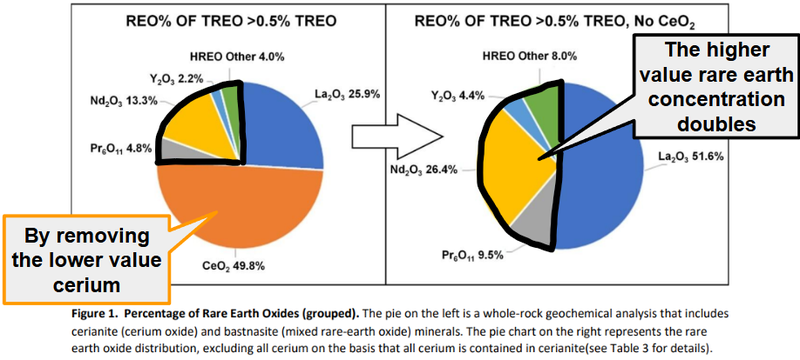
Cerium makes up roughly half of the rare earths at Morro do Ferro by mass but very little of the value.
So strip the cerium out, and PNN says the magnet rare earths make up about 40% by mass of what's left, which is roughly 98% of the value (based on PNN’s own pricing assumptions).
(source)
The historic drilling from the project backs this up also.
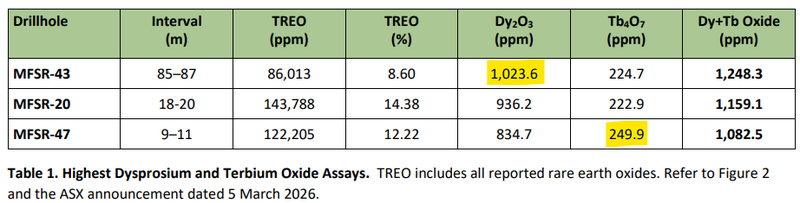
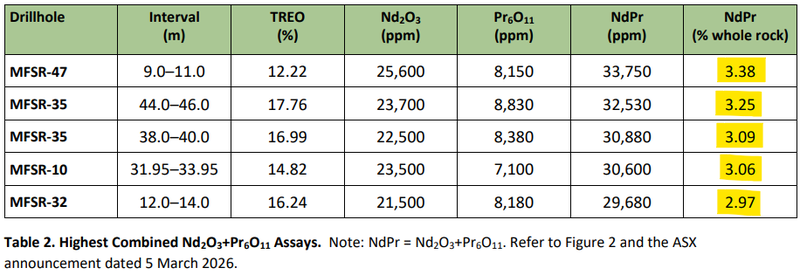
Across the existing database, PNN has peak grades of over 3% combined neodymium-praseodymium, plus dysprosium up to ~0.1024% and terbium up to ~0.025%.
These are the heavy magnet rare earths China controls most tightly.
(source)
Because the magnet rare earths and the cerium sit in different minerals, PNN’s theory is that the low-value radioactive cerium can be removed during mining and processing.
So PNN has said its future evaluations will focus on MREO grade and recoverable value per tonne, not total rare earth grade.
The goal is a premium magnet rare earth concentrate enriched in neodymium, praseodymium, dysprosium and terbium, the same 4 magnetic rare earths we mentioned earlier..
If the model holds up, PNN expects it could simplify the flowsheet, cut processing costs and lower the upfront capital.
What we want to see next from PNN
🔄Drilling at Brazilian rare earth project (Morro do Ferro)
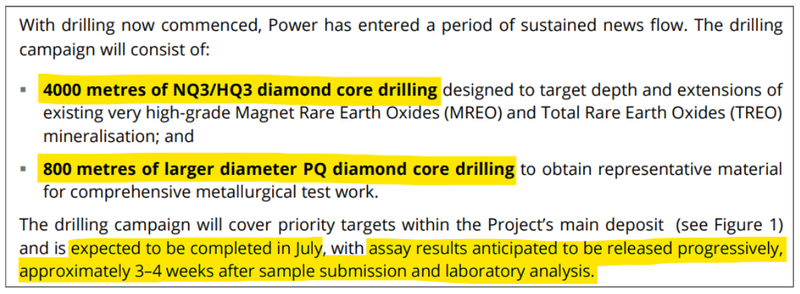
This week PNN got drilling underway at the project and assay results from this are expected in ~3-4 weeks from dispatch, so we should start to see these coming through in July:
(source)
We are hoping to see that the historical grades are confirmed and to see if the mineralisation extends from the historic drilling.
- ✅ Drilling underway
- 🔲 Early assays received (expected in ~3-4 weeks from dispatch, so into July)
- 🔲 All Assays Received
- 🔲 Maiden JORC Resource
There is also larger drill core size samples being taken for met testing:
- 🔲 Met samples taken and sent to lab
- 🔲 Met samples results received
🔄Mineralogy program at Morro do Ferro
Today PNN got a mineralogy program underway at MDF, where it will be looking at the ways for it to target the 4 valuable magnetic rare earths and strip out the waste early.
The goal of this is to show that the project will be able to produce a high grade and quality MREO product and investigate ways to improve the economics and efficiencies.
These works will also help PNN begin to factor in things like plant design and future mining strategies and also influence JORC resource results.